Group Riding

Before you can ride safely in a group, you must be able to ride confidently by yourself. It is beyond the scope of this website to teach you how to ride. If you haven't already taken a Riders Education course it is highly recommended, regardless of how long you have been riding. Courses are available through a few venues, including Harley Davidson® Rider's Academy, Minnesota Motorcycle Safety Center and others. One of the most over-looked skills seems to be Counter Steering, also known as Push Steering. To make a motorcycle turn to the right, you push on the right handlebar. That's right, you turn the handlebars in the opposite direction that you want to go. This isn't just a skill used for emergency swerving, it's how you ride a motorcycle. You don't steer a motorcycle by leaning, you make it lean by steering! If you veer towards the centerline making a simple right hand turn, you might want to Google counter-steering and unlock the secret to safer cycling.

Staggered Formation

ridestaggeredRiding in a group is easy and safe if you know the ground rules and everyone is on the same page. In the Twin Cities Chapter we ride staggered. This means the lead bike is always in the left half of the lane, and the second bike is in the right half-about 1 second back. Bike three is in the left half 1 second back.

While each bike is maintaining only a 1 second following distance, the distance between the bike immediately in front of you is 2 seconds and each bike has full use of the lane should they need it and in curves. Since there is no one riding next to you, avoid crowding the center-line or pavement edge.
 

These distances are commonly referred to as the “Two Second Rule” and may need to be increased from time to time, but try to avoid huge gaps that may encourage cars to enter or cross your lane. We used to use the “slide” method to fill the gaps, but Harley-Davidson and the MSF encourage leaving the gap or using the “Criss-cross” method instead. Twin Cities HOG has decided that should a gap in staggered formation occur, it would be best to leave the gap and correct it at the next stop sign or red light.

When stopped at intersections it is usually better to pair-up and tighten ranks. Each right-side bike moves up to be beside the left-side bike. If at a stop light, resume the stagger as you move out on the green. If at a stop sign, proceed through as a pair then resume stagger. Take turns as pairs with other traffic. Do not block traffic! As nice as that might be, none of us are deputized, and if something goes wrong you don't want to have to report to state that you ran a stop sign. This can get tricky as sometimes one of the cars will yield to us but the other side may not. Your default position is to exercise caution and follow the law.

Hand Signaling

We use hand signals to communicate with the group. This only works if everyone relays the hand signals back to the rest of the group.

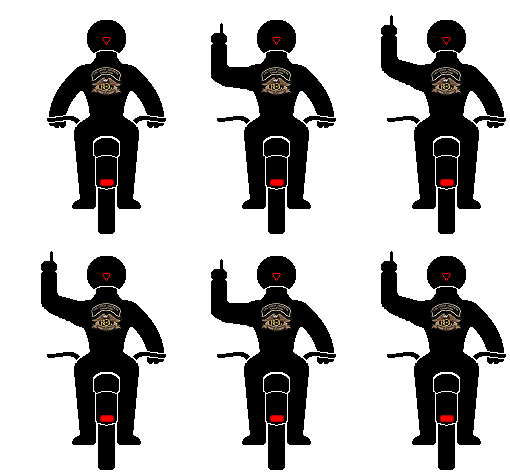
START ENGINES – With your right or left arm extended, move your index finger in a circular motion.

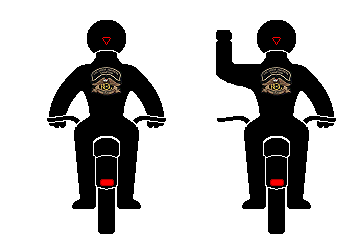
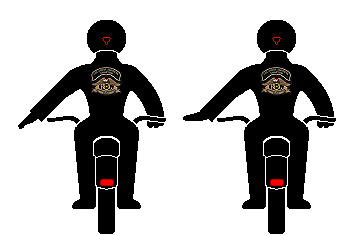
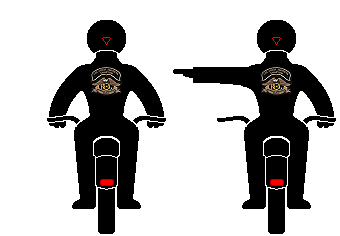
LEFT TURN – Raise your left arm horizontal with your elbow fully extended.

RIGHT TURN – Raise your left arm horizontal with your elbow bent 90 degrees vertically.

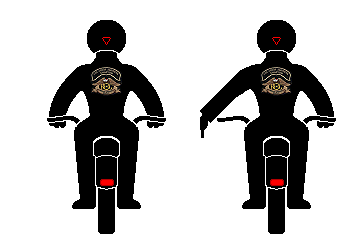
HAZARD LEFT – Extend your left arm at a 45 degree angle and point towards the hazard.

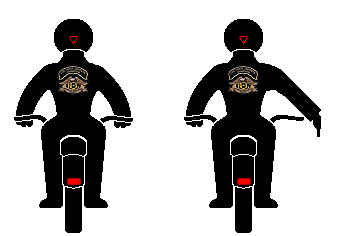
HAZARD RIGHT – A Extend your right arm at a 45 degree angle and point towards the hazard.

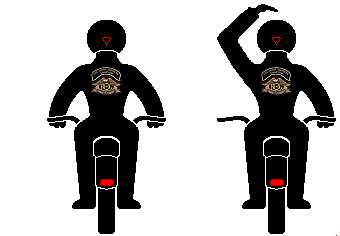
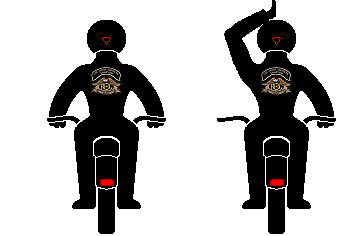
HAZARD RIGHT B – Extend your left arm upward at a 45 degree angle with your elbow bent to 90 degrees and point towards the hazard over your helmet. You may also point with right foot, just don't kick the roadkill!

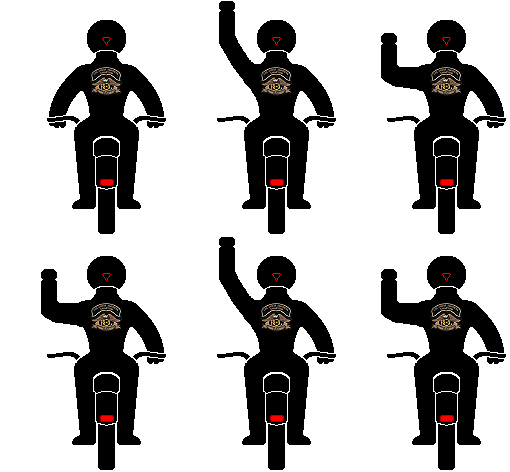
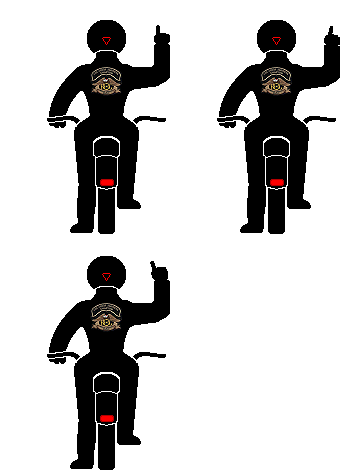
SPEED UP – Raise your left arm up and down with your index finger extended upward. This indicates the leader wants to speed up.

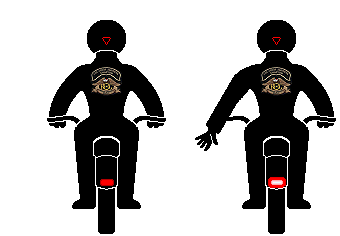
SLOW DOWN – Extend your left arm at a 45 degree angle and move your hand up and down.

STOP – Extend your left arm at a 45 degree angle with the palm of your hand facing rearward.

SINGLE FILE – Position your left hand over your helmet with your fingers extended upward. This indicates the leader wants the group in a single file formation. Usually this is done for safety reasons. Signal may also be hand raised with index extended.

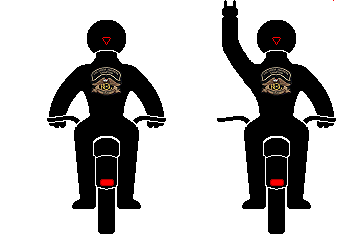
STAGGERED or SIDE-BY-SIDE FORMATION – Extend your left arm upward at a 45 degree angle with your index and pinkie finger extended. This indicates that it is safe to return to staggered formation.

TIGHTEN UP – Raise your left arm and repeatedly move up and down in a pulling motion. This indicates the leader wants the group to close ranks.

Motorcycle Safety Tips

Basics

  • Assume you are invisible.
  • Get comfortable with being uncomfortable
  • Never stop learning new skills. Quote from UCLA coach John Wooden If you are through learning - you are through
  • Your hands will follow your eyes therefore, the bike will go where you look
  • Do not think you are better than you are
  • Increased tire traction comes from friction which comes from more weight on the tire
  • Always have some traction in reserve
  • Mirrors should only show your elbows in order to get a wider view
  • Do not trust a red light, stop sign or blinker (My Honda)
  • Consider shopping center parking lots as a hazardous zone
  • Look ahead up to 12 seconds if possible
  • Eye scan: left - center - right - then center - left
  • Usually, a bike will not tip over as long as there is power to the rear wheel and moving at least 12 mph
  • Less than 12mph the bike will be victim to gravity and will usually dump
  • When riding with strong side wind try to relax, reduce your body size by hugging the gas tank with your knees and use a loose hand grip
  • Everything takes longer when having a passenger (stopping, accelerating turning, etc)

Rain

  • The first part of the rain is the most slippery due to road grime, oil, antifreeze, etc has not yet washed away
  • Ride in the two outside lanes (1 and 3) not the middle ofthe lane (2)
  • Tire friction can be reduced by 40%

Cornering

  • There are more accidents on right hand curves than left hand
  • Find your path before you lean
  • Turn your head, shoulder and chest to the direction you want to turn
  • Enter curve with best view forward (left part of lane on a right-hand curve)
  • Exist a curve faster than you went into it
  • Release brakes if you have to swerve

Breaking & Stopping

  • Step 1: Perception of the environment
  • Step 2: Reacting to the environment
  • Step 3: Braking
  • (The longer it takes for steps 1 & 2, the longer it will take to stop)
  • The front tire has the most stopping power
  • There is a lack of agreement on riding the front brake
  • Eyes up and head up
  • Keep the handlebars straight
  • Breaking hard with the handlebar turned will dump the bike
  • You should be able to stop within 18 feet at 25MPH
  • Give space between you and the vehicle in front of you ... no tailgating
  • Use mirrors before braking to see what is coming behind you and how fast
  • Look for an exist to avoid getting rear ended

Slow U-turns or circles

  • Turn your head, shoulder and chest to the direction you want to turn
  • Light pressure on rear brake
  • Get into the gray friction zone on the clutch
  • Use some rpm beyond idle speed

Lane splitting and lane filtering will be legal in Minnesota as of July 1, 2025. Motorists and motorcyclists need to be aware of this new law and how it will affect them to ensure it is enacted safely and respectfully on Minnesota roadways.

Lane splitting is allowed when two or more lanes of traffic are traveling in the same direction and traffic is moving. It allows a motorcycle to pass another vehicle in the same direction of travel and in the same traffic lane only under these conditions:

  • At no more than 25 miles per hour.
  • No more than 15 miles per hour over the speed of traffic in the relevant traffic lanes.

Lane filtering is allowed when two or more lanes of traffic are traveling in the same direction and traffic is NOT moving. It allows a motorcycle to move through traffic that is stopped, such as at a traffic light or traffic jam, only under this condition:

  • No more than 15 miles per hour over the speed of traffic in the relevant traffic lanes.
Image showing motorcycles lane splitting in moving traffic from aboveImage showing motorcycles lane filtering in stopped traffic at a stoplight.


Lane splitting and filtering cannot be performed under the following circumstances:

  • At the approach, drive-through, or exit of a roundabout.
  • In a school zone.
  • In a work zone where only a single travel lane is available for use.
  • On an on-ramp to a freeway or expressway.

Motorcyclists:

  • It is your responsibility to determine if these maneuvers can safely be performed in a given situation.
  • Do not perform them if you cannot do so safely and within the legal speed restrictions.

Motorists:

  • Be aware of motorcycles sharing your lane in slow-moving traffic and when stopped at intersections.
  • Do not impede their legal right to do so.

Information provided by MMSC’s website.